Gold Digger's Mouth
On Izikhotane, the Italian baroque, destruction as grammar, the Red Queen ko kasi Or what happens when a subculture becomes someone else’s finishing move.

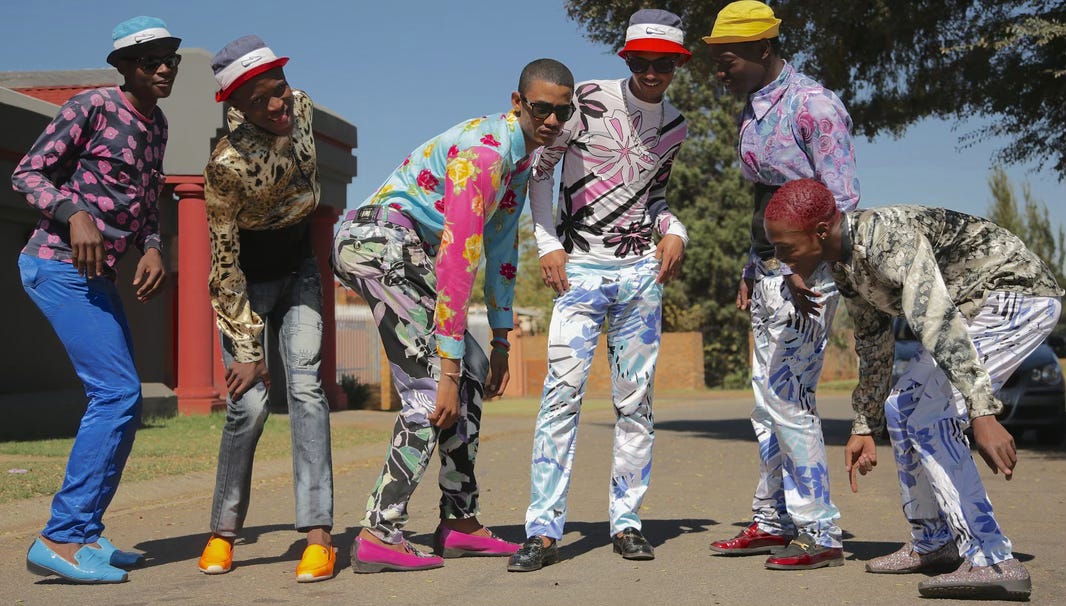
I. The Decoy
Start with what the category cannot hold. Waste. That is the word consistently levelled at izikhotane — that label, at once diagnostic and dismissive, which promises understanding while foreclosing it. To call izikhotane waste is to arrive at the scene after the act, look at the stain of Ultramel on a burnt Italian shirt, and conclude you have understood the event. You have understood nothing. You have merely confirmed your prior. The waste is a decoy. The decoy is the whole point.
When South African luxury house MaXhosa Africa closed its Autumn/Winter 2026 runway presentation in Paris — the Siyi’Kulture collection, their fifth consecutive appearance on the official Paris Fashion Week calendar — a group of dancers and media personality Robot Boii poured Ultramel custard onto a MaXhosa carpet. The act was meant as homage. What it triggered instead was the most clarifying argument about a subculture South African Black Twitter has had in years. The argument was not really about Robot Boii. It was not really about MaXhosa. It was about the object — the skhothane — and what becomes of an object when someone else picks it up and uses it as a finishing move.
The custard is the hinge. It migrates from Thokoza Park in Soweto to a packed building in the 8th arrondissement, and in that migration it changes everything except its consistency. Thick. Yellow. Irreversible once poured. The same Ultramel, but no longer the same act.
THEORETICAL FRAME I · SOCIETY OF THE SPECTACLE
Guy Debord, writing in 1967, described the spectacle not as a collection of images but as “a social relation among people, mediated by images.” The spectacle does not merely show — it replaces. What was once directly lived becomes its own representation, and that representation, evacuated of the original living, circulates freely, changeable by whoever holds distribution rights. The spectacle’s central operation is precisely this: it takes something that required a body in a specific place to be meaningful, and makes it available everywhere to everyone, meaning nothing in particular.
Izikhotane was never about custard. The Ultramel was always a vehicle. What the Ultramel announced — in Tembisa, in Katlehong, in Diepsloot — was a relation of forces: I have enough to waste this. I am beyond the reach of scarcity. My abundance is so total I can destroy what you cannot afford to own. The custard was not the statement; the custard was the punctuation to a statement about social standing, about selfhood recovered from under the rubble of post-apartheid inequality, about young Black men performing an impossible sovereignty in the only arena that had ever admitted them.
On a Paris runway, the custard is punctuation to a different sentence. It has been promoted, and in being promoted, it has been emptied. Debord called it recuperation: the spectacle intercepts radical gestures, commodifies them, reinserts them into the mainstream where they function as style, as edge, as a flavour of the real without the consequence of the real. The custard in Paris is recuperated custard. It is custard as concept art. And concept art — aowa, haai — has never made anyone’s pulse jump like Gold Digger biting his iPhone with a gold grill.
“If I can burn this two point three shirt, who are you? You are no one.”
— Gadlamba , a Skothane from Thokoza Park, Soweto, circa 2014
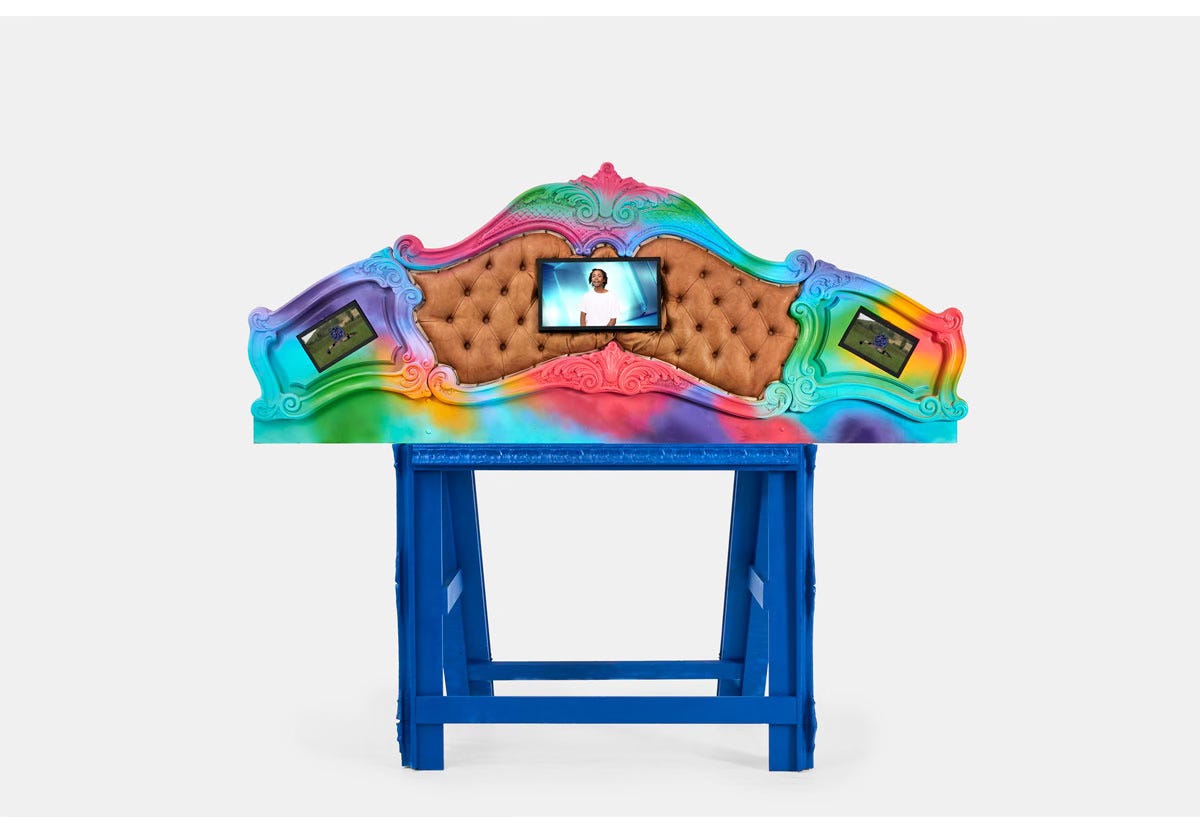
II. MaTariana: On Being the Original
But to understand what the custard meant before it reached Paris, you have to understand what izikhotane understood about themselves long before Paris showed any interest. They called themselves MaTariana. The Italians. Not ironically, not aspirationally — ontologically. The name is a declaration of identity, not of imitation, and the distinction is everything.
When Bogosi Sekhukhuni still lived in joburg he observed something that most analysis of izikhotane misses entirely: that there is a genuine and deep convergence between Black township aesthetic sensibility and Italian baroque taste that precedes and exceeds any individual purchase of a DMD shirt or a pair of Rossimoda Pagani loafers. Walk into a Soweto home and look at it honestly. The heavy brocade curtains. The lounge suite with the plastic still on — preserved, precious, never allowed to degrade from its ideal form. The baroque bed base and headboard, the ornamented ceiling, the chandelier in a room that size has no architectural reason to contain one. These are not imported tastes. They are parallel productions. Two cultures, arriving from entirely different histories of exclusion and aspiration and religious pageantry, converging on the same aesthetic logic: that beauty should be excessive, that abundance should announce itself, that ornamentation is not decoration but argument.
Before Takashi Kurasawa jeans entered the streets of Pirara around 2006, the number one jean among matsatsantsa le dikhotane was Diesel. Not because Diesel was the most expensive option available. Because Diesel was Italian. The logic was already in place. The preference was already structurally coherent. The skhothane did not discover Italian aesthetics through a brand catalogue; they recognised a family resemblance. When they put on the DMD shirt or the Rossimoda loafer, they were not copying. They were confirming something they already knew about how beauty works, how display works, how the surface of a thing can be a form of argument about the interior.
THE SIMULACRUM
Baudrillard’s simulacrum is commonly understood as a copy that has lost its original — a representation so divorced from the real that it no longer refers back to anything. But the more precise and more devastating version of the concept is the simulacrum that never had an original to begin with: the copy that is not a copy because the thing it resembles was arrived at independently, from different coordinates, by different routes. This is not imitation. This is convergence. The township baroque is not a degraded version of Italian baroque. It is Italian baroque’s equal, produced under different pressure, carrying different stakes.
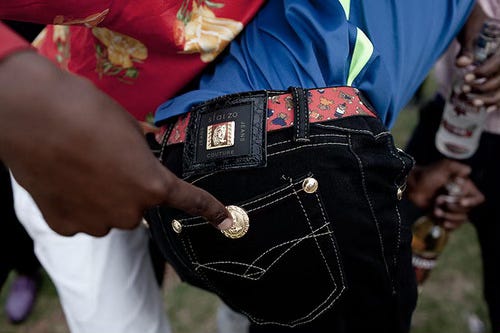
This reframes the entire phenomenon. When izikhotane wear Rossimoda and Versace and DMD — when they call themselves MaTariana and mean it — they are not performing aspiration toward a European ideal. They are recognising a cousin. The aesthetic convergence Sekhukhuni describes collapses the distance that the usual narrative of “poor kids buying things they cannot afford” depends on. That narrative requires a gap: between the thing’s proper context (European wealth, European taste) and its improper context (township, scarcity). But if the aesthetic logic was already present in the township — in the curtains, in the lounge suite, in the headboard — then there is no gap. There is only recognition. The Italian brand arrives and the skhothane says: ngyakuzwa. I know you.
And here is the irony that the Paris runway could not contain: when izikhotane finally arrived in Europe, Europe did not recognise that Europe had already arrived in Katlehong. The aesthetic conversation had been happening for decades, on one side only, without acknowledgment. MaTariana walked into the room and the room thought it was seeing a novelty. What it was seeing was a mirror.
III. The Arms Race You Cannot Win By Standing Still
Before the spectacle was theorised, it was lived. The diamondfield dandies of Kimberley in the 1880s wore expensive suits in the dust of the mining compounds where they were worked nearly to death. The oswenka of Jeppestown in the 1950s competed in sartorial battles that were not about fashion so much as they were about insisting on personhood under a system designed to deny it. The pantsula reappropriated the gardening uniform — the very costume of their subjugation — and made it a language of aesthetic authority. Each of these subcultures is a point in the same long line. The township has always known how to dress as an argument. Izikhotane is not the beginning of this logic. Izikhotane is its most recent, most extreme, most theoretically self-aware iteration.
THEORETICAL FRAME II · THE RED QUEEN HYPOTHESIS
Leigh Van Valen proposed in 1973 that species must continually evolve simply to maintain parity with co-evolving rivals — that standing still, in a world of mutual pressure, is effectively moving backwards. He named this after Lewis Carroll’s Red Queen, who tells Alice: “it takes all the running you can do, to keep in the same place.” The hypothesis describes what biologists call an arms race: a dynamic in which every adaptation in one organism triggers a counter-adaptation in the other, driving escalation without rest. The race does not end. There is no winning; there is only the running.
Izikhotane is a Red Queen culture. From its emergence in the East Rand townships around 2005, it has always been structured as an escalating arms race between crews — not against an external enemy, but against one another, in the productive competition of display. You show up in a Rossimoda loafer; I show up in three pairs of DMD trousers. You pour Ultramel on your shirt; I set my shirt on fire. You destroy something worth a month of wages; I destroy something worth two. The logic is not waste — the logic is ukugqivisa: to outdo, to outperform, to force the other crew to escalate or concede. The Ultramel is not the end point. The Ultramel was always the opening move in the next round.
What the MaTariana framing adds to this Red Queen analysis is a ground beneath the escalation. The arms race is not arbitrary. It is not random conspicuous consumption. It is an arms race conducted in a specific aesthetic language that the participants understand as theirs — that they understand as beautiful, as correct, as the proper idiom for what they are trying to say. You cannot understand why the escalation takes the forms it takes — why Italian brands specifically, why baroque excess specifically, why the particular combination of the ornate and the destructible — without understanding that the township already had an aesthetic philosophy, and that philosophy rhymed with Italian baroque before it ever consciously engaged with it.
Which is why what happened in the park — the memory I carry without needing anyone to confirm it — was not spectacle. It was sport. It was war. It was art. A crew called Maswitsi against a crew called Sportavelas, and a young man called Gold Digger, and a grill in his mouth, and an iPhone 8 he was about to destroy for the pure uncontractable reason that he could, that the doing would be unassailable, that no counter-move existed on the day that could answer it. He bit down. The screen cracked. The crowd went — I cannot find the English for this — not wild, not silent, but something between reverence and riot. I have stood in galleries at openings and watched people perform appreciation. I have seen nothing that moved the body the way that moment moved the bodies around me in that park.
INTERLUDE · THOKOZA PARK, JOHANNESBURG
Two groups assembled. A crowd around them — not an audience, something older than an audience, a monyanyako, a gathering that was part of the event. The gumba music loud enough to make your sternum a percussion instrument. The Sportavelas opened strong: coordination, colour-saturation, destruction staged with the precision of choreography. Maswitsi responded. Back and forth. This is the Red Queen in the flesh: two organisms driving each other to the edge of what is possible.
Then Gold Digger stepped forward. He did not announce himself. The grill caught the afternoon light — gold, baroque, excessive, completely correct. The iPhone was a current model. He held it up — a moment of suspension, the crowd contracting inward — and bit down, and the screen cracked front and back, and the piece was over. Not because anyone said so. Because there was nowhere to go from there. The evolutionary ceiling, at least for that afternoon, had been reached.
I have never seen a gallery or museum work achieve that kind of foreclosure (except perhaps Arthur Jafa’s Love is the message, the message is Death). The best I have seen in a white cube is a kind of extended ambiguity. What Gold Digger did was different: waphela impela. It finished everything. And the grill in his mouth — MaTariana to the end — was the most Italian thing I have ever seen in my life.
IV. The Name That Won’t Come, and What That Costs
Here is what the category of waste cannot hold: the precise phenomenology of that moment, which was a moment of total presence, of social time compressed into a single irreversible act, the opposite of spectacle precisely because it could not be replicated, could not be resold, could not be streamed. The iPhone was broken. The breaking was the thing. The breaking was ukugqivisa taken to its logical terminus — the only authentic terminus of an arms race, which is the point at which one party simply cannot go further.
Debord wrote that the spectacle turns “the decline of being into having, and having into merely appearing.” Izikhotane, in its originary form, inverts this progression. The skhothane does not merely appear to have — he destroys what he has, and in destroying it performs a having so total it transcends the object. The shirt is not an object, it is an argument. The burned money is not money — it is the refusal of money’s logic. The bitten iPhone is not a consumer product — it is a monument to the freedom that consists in the ability to destroy what money buys. This is not waste. This is a theology of sovereignty, practised by people whom the post-apartheid dispensation gave nominal freedom and kept materially dispossessed.
And the Italian brand in this equation is not incidental. The choice of Diesel over a cheaper jean, of Rossimoda over a more affordable shoe, of Versace over a local label — these are not status moves in any simple sense. They are aesthetic moves. The skhothane is selecting the object that is most philosophically consonant with his own aesthetic logic: the baroque, the ornate, the premium, the thing that announces its own value in excess of its utility. When he destroys that object, he is not destroying a European brand. He is destroying the most perfect available materialisation of his own aesthetic philosophy. That is the sacrifice. That is what makes it sacred.
“Get the original people to do it. It does not look properly executed.”
— @snezuluh on X (formerly Twitter), March 2026
The tweet is devastating precisely because it understands something the runway couldn’t accommodate: that the epistemology is in the body, and you cannot hire the epistemology. The skhothane who pours Ultramel knows something about the crowd’s judgment, about the invisible tribunal of the community, about the stakes of being seen to fail in the arms race — all of which makes the act legible. Remove the stakes, stage the act, choreograph the destruction, and what you have left is custard on a carpet. The referent has been severed from the reference. In Paris, no one could have made the choice not to escalate. Everyone was hired. Haai whabo?. That is the whole problem.
V. Recuperation, and What Survives It
The response on Black Twitter was passionate in a way that confused some commentators. Why does it matter, they asked. It is just custard. Why are people angry about custard? The question is itself a symptom. The people who ask it have never had their own self-invented grammar mistranslated in front of an international audience, their vernacular used as decoration for someone else’s fluency claim. The passion is the Red Queen mechanism in the social sphere — the subculture running as fast as it can to stay ahead of the thing that is chasing it, which is no longer just class anxiety or racial dispossession, but now also the aestheticisation industry, the global appetite for “African streetwear,” the machinery that converts township creativity into runway capital without returning to the township the dignity of accurate citation.
There is also something specific here about the Italian dimension that this critique exposes. When MaXhosa, a Xhosa heritage brand, borrows izikhotane — a subculture whose aesthetic identity is specifically and consciously MaTariana — and presents it on a Paris runway to an international audience that has no framework for understanding the township-baroque convergence, what gets communicated is: African street culture. The specificities collapse. The Italian layer, which is the most philosophically interesting layer, the one that makes the simulacrum argument possible, the one that reframes the whole thing from imitation to convergence — that layer is invisible. What Paris sees is colourful and exuberant and African and foreign. What Paris sees is not MaTariana. Paris has never heard the name.
THE CONVERGENCE
What Debord and Van Valen together describe is a world in which no gesture remains where it begins. Recuperation is the spectacle’s version of the Red Queen: every subversive adaptation is met with a counter-adaptation from the dominant culture, which absorbs the adaptation, neutralises its charge, and incorporates it as product. The skhothane destroys a shirt; the spectacle markets a shirt inspired by the destruction. The cycle does not stop. The question is not whether recuperation will happen — it will, it always does — but whether anything survives recuperation. The Red Queen says: the only way to survive is to keep running, to keep generating novelty faster than the predator can absorb it.
What survives recuperation is not the gesture. The gesture is gone the moment it is legible to the machinery. What survives is the epistemology — the knowing-in-the-body that produced the gesture and will produce the next one, and the one after that. Material Don Dada — Tshepo Pitso, born in Vaal, now with half a million Instagram followers, designing his own line for DMD Muracchini Linea Italiana, now the subject of a reality TV show on Mzansi Wethu — is also recuperated. He is also running in the Red Queen. But something in him knows something about the park that the runway does not know. That knowing will generate the next move.
VI. The Object, Circulating
The Ultramel carton. Let us track it. It begins as a product of a South African dairy company, a yellow carton available in any Spar or Pick n Pay, associated in South African popular consciousness with Sunday lunch, with umsebenzi, with the particular sweetness of a dessert that is unambiguously ours — not aspirational, not imported, perhaps prestigious. The skhothane picks it up and makes it precious by making it destructive: the Ultramel is valuable in the performance precisely because ordinarily it is not. Its very ordinariness becomes the subversion. I am so abundant that I can destroy abundance with abundance. The carton, in the township park, is a readymade — Duchamp’s urinal in Katlehong.
Note the structure of that inversion. The Rossimoda loafer is already a baroque object — it arrives precious. The Ultramel carton is a humble object made momentarily precious through the act of destroying it alongside the loafer. The two objects in the same performance space create a dialectic: the Italian and the township, the imported and the homegrown, the aspirational and the everyday, all destroyed together. This is not accidental. This is compositional intelligence. The skhothane is curating a tableau in which the convergence Sekhukhuni describes — Italian baroque and township aesthetic — is enacted, then annihilated, then rendered more vivid by the annihilation than it could have been by any other means. You cannot understand the custard without the loafer. You cannot understand the loafer without MaTariana.
Then the carton migrates. It reaches a luxury fashion presentation in Paris. Now it is precious in a different register: it is authentic African street culture, it is global South creativity, it is the kind of signifier that makes international fashion editors feel they have touched something real. The carton is the same carton. What has changed is the relation it mediates — which is no longer between two crews disputing dominance in front of a crowd that will hold them accountable, but between a South African brand and an international market that wants proof of roots.
Debord said the spectacle is the flip side of money. The Ultramel carton in Paris is not Ultramel. It is Ultramel as spectacle: the image of Ultramel, circulating, generating value, cut loose from the living relation it once mediated. The social relation it originally expressed — the epistemology of the park, the tribunal of the crowd, the Red Queen logic of escalation, the baroque philosophy of
MaTariana — has been abstracted away. What remains is yellow and thick and pouring slowly down onto a carpet that costs more than a month’s rent in Tembisa.
VII. What Waste Cannot Hold
Return now to the category. Waste. The diamondfield dandies were waste. The oswenka were waste. The pantsula were waste. Izikhotane are waste. Each generation of waste more legible to the generation after it — the diamondfield dandy recoverable now as proto-resistance, the oswenka now respected, the pantsula now on Beyoncé’s stage — while the current generation of waste is not yet legible, not yet recuperated into something the larger culture can praise without misunderstanding it. It is in the discomfort zone: not yet history, not yet product, still doing the thing it needs to do.
The category of waste cannot hold the fact that destruction — deliberate, sovereign, communally witnessed destruction — is a form of production. What is produced is not a commodity. What is produced is a relation: the skhothane who destroys something has forced everyone present to acknowledge that he exists, that his existence is not reducible to the object he has just destroyed, that his selfhood exceeds any sum of his possessions. The terminus of this argument is: the act of destruction is a proof against the spectacle’s most fundamental proposition. Debord says having becomes appearing. The skhothane says: I will demonstrate that I have so thoroughly that I will destroy the evidence. Appearing is insufficient. Being requires the destruction of its own proof.
The waste category also cannot hold the MaTariana layer — cannot hold the fact that the objects being destroyed are not random brands but a specific aesthetic philosophy made material, that the destruction is therefore a form of philosophical sacrifice, that the Rossimoda loafer going into the fire is not extravagance but argument: I understand beauty well enough to burn it. The baroque tradition, in its European form, built cathedrals to say something similar — that the most serious arguments about what matters are made not in prose but in excess, in ornament, in the willingness to use the best materials for something beyond utility. The skhothane knows this. MaTariana always knew this.
This is why the Maswitsi winning move landed the way it landed. Gold Digger did not merely win a dance-off. He performed an ontological argument. He said, in a grammar that required no translation: ngiyaphila. I am alive. Not as a citizen, not as a consumer, not as a demographic, not as a target market. Alive as a subject who acts, whose action is irreversible, whose moment cannot be curated after the fact. The iPhone is broken. It cannot be unbroken. That is the thing the gallery cannot give you, and the runway cannot give you, and the tweet cannot give you. Only the park, and the crowd, and the act itself.
∗
VIII. Coda: The Plastic, Still On
The category of waste collapses now under the weight of what we have seen. Not because waste is wrong as a description of the surface — things are destroyed, yes — but because waste as an explanation mistakes the surface for the depth. The depth is this: a culture that has been told for generations that it cannot afford beauty, cannot produce value, cannot generate the kind of selfhood that warrants respect, has invented a grammar of sovereignty through destruction. And that grammar is not an imitation of any European grammar. It is a parallel production, arriving at the same conclusions about excess and ornament and the baroque, from its own interior logic, confirmed but not originated by the Italian brands it eventually chose to wear.
The lounge suite with the plastic still on is the key image. It is preservation as argument: I will not let use diminish what I have. I will protect the beautiful thing from the ordinary. I will keep it more perfect than function requires because perfection is the point, not function. This is baroque logic. This is MaTariana logic. This is izikhotane logic. The plastic is not poverty — the plastic is philosophy. The skhothane who burns a DMD shirt is performing the inverse of the same gesture: I will not let possession diminish what I have. I will release the thing at its peak because the peak is the point, not the accumulation.
When that grammar is borrowed — by a luxury house, by a runway, by a well-intentioned dancer in Paris — something real is acknowledged. The acknowledgment is not nothing. But the gesture also does what Debord said the spectacle always does: it converts a lived relation into its image and sends the image circulating. The image circulates now in Paris and Johannesburg and Lagos and on your timeline, yellow and thick, generating engagement, generating debate, generating this essay. The original act — the park, the crowd, the irreversibility, the baroque philosophy of
MaTariana confirmed in the moment of destruction — stays where it was. In Thokoza Park. In Katlehong. In the memory of everyone who was there when Gold Digger bit down and something finished.
Both parts persist. That is the devastating part. The custard pours in Paris. And somewhere, ko-kasi, someone is figuring out the next move. Someone is standing in front of a wardrobe full of Italian clothes — MaTariana to the last button — deciding which one to burn. The Red Queen does not rest. The plastic is still on the lounge suite. The lounge suite is still perfect. The arms race has no finish line.
This essay draws on Guy Debord’s The Society of the Spectacle (1967) and Leigh Van Valen’s Red Queen Hypothesis (1973), Jean Baudrillard’s theory of the simulacrum, and the cultural observations of Bogosi Sekhukhuni on the convergence of Black township and Italian baroque aesthetics. The scene at the park is a personal account. Gold Digger is not a metaphor. The MaXhosa Africa Siyi’Kulture collection debuted at Paris Fashion Week on 8 March 2026.
A few thoughts.
One is whether izikhotane might be interested in an arts mentor to deepen their creativity to states of embodiment outside fancy garb.
Then, I would like to see this custard act on a Paris runway being replaced by a fire: kerosene, parafin, good old petrol. What prevented them for being the izikhotane they are at home? Who curated the performance? What discussion did not take place?
Then, what keeps them from burning, embody burning and be prepared to embody the body of the African male in Paris.
Just a few thoughts.
Fascinating and provocative. Appreciation for both your writing and understanding and for Nobonke's responses. I am not an artist. I am not young or black or male. Simply - to some extent culpable - curious and grateful.