On Libido
Notes on Sex and the Libidinal Economy

The thing nobody warns you about is that it can just go quiet.
Not gone. Quiet. Like a room where a fridge you’d long stopped hearing switches itself off, and there’s suddenly a silence you didn’t know was being filled. For about a year now, maybe a bit longer, the part of me that used to run the whole show has been idling on some low setting, and I keep waiting for it to climb back up to pressure, and it keeps not.
I don’t know how to write about this without either confessing too much or burying myself under enough theory that you can’t see me at all. Let me try to stay in the frame.
In my twenties I was broke and I was constantly, stupidly aroused. I want to be careful not to romanticise it, but I also can’t lie. I had a room in a flat in New Doornfontein, a mattress on the floor, no airtime for half the month, and whole days with nothing in them. Desire filled the days because nothing else was competing for the space. I wasn’t producing anything. Nobody was waiting on me for anything. My time was a wide empty field, and the body does what bodies do in a field. It wanders. It wants. I had nothing to do and everything to feel.
Now I have a calendar. I have the kind of life that looks, from the outside, like arrival. Work I actually care about, which is the trap of it, because you can’t resent work you love in the ordinary way. You just let it eat you and call the eating commitment. And somewhere in all that arriving, the wanting thinned. Sex migrated. It used to be the main event and now it’s an item, and some nights I can feel it sitting on the same list as the unanswered emails, and I do it the way you do the last thing on a list. Competently. A little absently. Relieved when it’s ticked.
I don’t know how to feel about that. I keep reaching for the feeling and finding a shrug. That might be the most honest sentence in here.
I read Byung-Chul Han on a plane, I think it was, over the top of some half-finished funding application, and I remember the small private horror of being described so precisely by a man who has never met me. He has this idea that we’ve become achievement subjects who exploit ourselves and experience the self-exploitation as freedom. That the burnout isn’t the system breaking down, it’s the system running correctly. And in a thinner book he argues that eros is dying, not from the old repression our grandparents were warned about, but from too much positivity, too much yes, too much self and not enough of anyone genuinely other. The achievement subject, he says more or less, can’t really love, because love asks you to disappear a little into someone else, and the achievement subject is far too busy optimising the self to go and disappear anywhere.
Maybe that’s too neat. He’s a very quotable pessimist and I don’t entirely trust how good his sentences make me feel about my own exhaustion. But the diagnosis lands. The work didn’t only take my hours. It took the thing that was living underneath the hours.
There’s an old idea, Freud’s really, that the artist’s making is libido rerouted, desire that couldn’t go where it wanted so it went into the work instead. Sublimation. For years I believed some version of that about myself. That the horniness and the making were the same current, and that I was one of the lucky ones who’d found a respectable pipe to run it through. But I’m not sure the pipe survives contact with how this actually feels. It doesn’t feel like my desire got redirected into the work. It feels like the work drank it. There’s a difference between a river changing course and a river being pumped dry, and I honestly cannot always tell which one happened to me. Maybe both. Maybe on different Tuesdays.
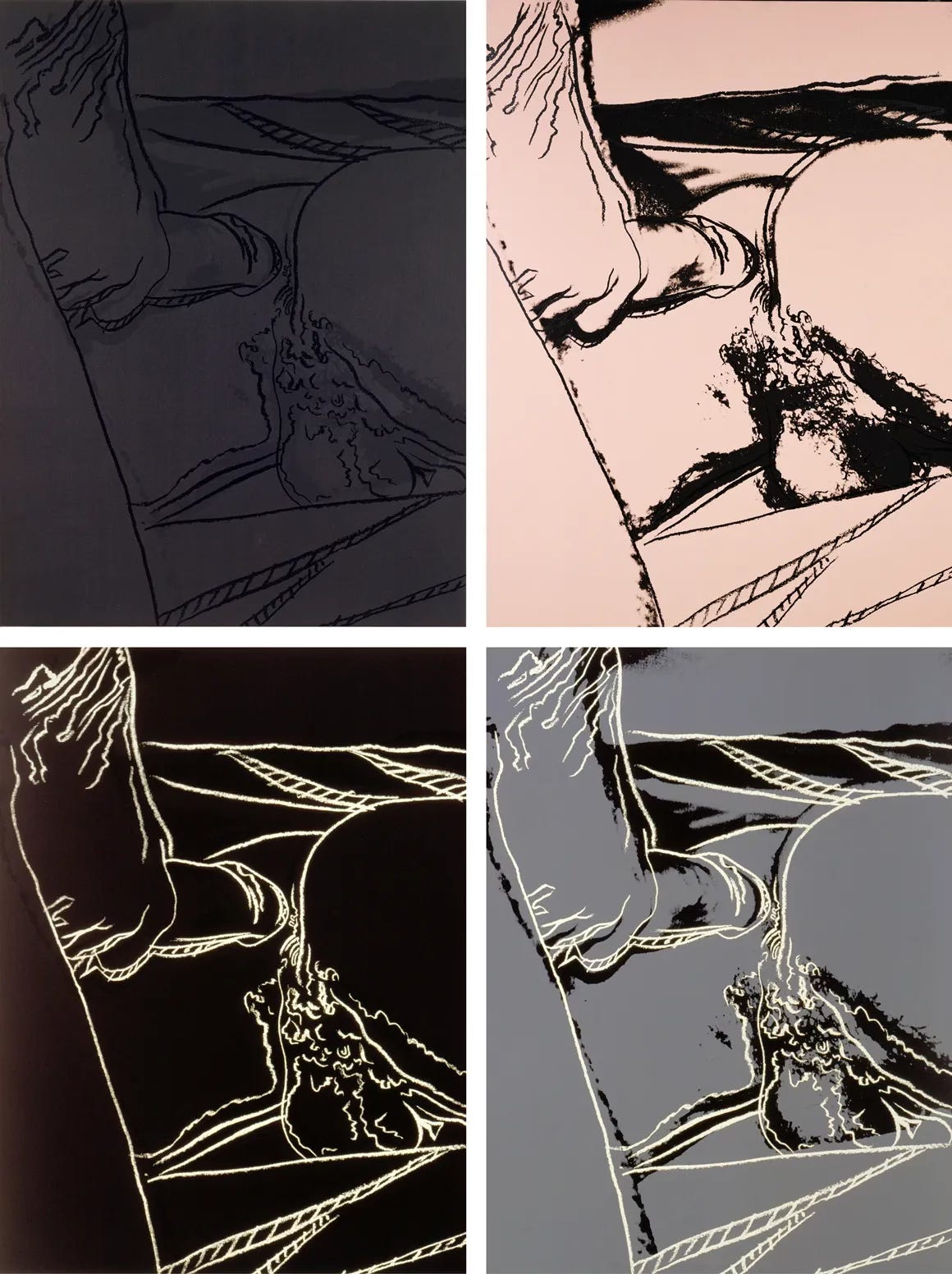
Andy Warhol put it more plainly than any of them, plainly in the way only he could, deadpan and half joking and entirely serious at once. Somewhere in his philosophy he divides everyone into two kinds, the people who get energy from sex and the people who lose it, and he’d worked out long ago that he was firmly the second kind. Too much work, he says. He’d rather be in his room making something, or cleaning. For years I read that as a pose, the professional weirdo doing his act. I don’t read it that way now. I know exactly which of his two types I am, and I’ve probably always been it, and I spent my twenties mistaking a glut of empty time for a glut of appetite. There’s a version of Warhol that is just sublimation carried all the way to the end, a man who poured every last unit of it into the work and the Factory and the fame and kept nothing back for the bed. Some afternoons that doesn’t read to me as a tragedy at all. It reads as a decision.
And then there’s what happens to desire when it does turn up, tired, at eleven at night, in front of a screen. I’ll be honest that the version of arousal most available to me now is the one that asks nothing of me and no one else. A tab. Then another tab. The blue light doing its work.
Amia Srinivasan writes about porn as a kind of education. That for a whole generation it arrived before experience did, and taught the imagination its grammar before the body ever got a turn. She’s careful about it, she isn’t doing the easy panic. But the thought sits in me like a swallowed stone. We didn’t learn desire and then go looking for pictures of it. A lot of us learned the pictures first and then went out hunting for a desire to match. Paul Preciado, who treats all of this as a single machine, calls ours a pharmacopornographic age, the body run by molecules and images, by dopamine and the screen, desire farmed like any other crop. Farmed. That’s the word that keeps me up. The suspicion that the wanting isn’t even fully mine, that it’s been grown in me for a yield.
There’s a whole subculture online now, gooning they call it, people who make a practice of it, almost a devotion, hours of edging in front of an endless feed, chasing the trance rather than any ending. I find it both alien and completely legible. It’s the last stop on a train I’m clearly already on. Desire with the other person removed, and the friction removed, and the risk removed, and the unpredictable weather of somebody else’s body removed, until what’s left is a nervous system being played like an instrument by an industry that has studied it far more closely than any lover ever bothered to.
The libidinal economy was Lyotard’s phrase, more or less, the notion that desire isn’t sealed off from economy, that it flows and pools and gets captured and invested like any other energy in the system. I used to find that idea abstract, a bit undergraduate. I don’t anymore. I can feel the capture. I can feel my own attention being harvested at two in the morning, and the harvest is efficient, and I am somehow the crop and the customer at once.
I said a version of all this out loud once. I posted something on a bad night about not having much of a libido anymore, and within the hour a small crowd had gathered in the replies to ask whether I work out. Do you lift. Have you had your testosterone checked. Try cold showers. As if desire were a muscle group I’d let go slack, as if the whole of it could be sorted with a protocol and a supplement stack, which is of course precisely the logic I’ve spent this essay describing, the one that treats the self as a machine with a maintenance schedule. I do cycle. I’ve a road bike I love and I ride it hard, and it has done exactly nothing for this, and I never expected it to, because I don’t believe the problem lives in my legs.
What I couldn’t say in the replies, because you can’t, is that the surprise underneath the advice had a particular flavour. People seem to assume, for reasons I can more or less guess, that a man who looks like me comes pre-loaded with appetite, that the body itself is a kind of promise. There’s an old and heavy script that issues certain bodies a libido whether or not they were born holding one, and to stand up and admit the tank is low is to let down a fantasy that was never mine in the first place. So the shame turns up right on time. The specific shame of having been told, more or less your whole life, that you are supposed to be effortlessly good at a thing, and quietly knowing that you are not.
I went looking, the way you do when you get tired of contemporary diagnoses that are all so confident about how doomed you are, for something older. The Daoists had a word, jing, for a kind of vital essence, close to what we’d call sexual energy but not only that, a root-stuff you’re born holding a portion of, which you can spend or bank. Their alchemists talked about refining it, turning jing into qi and qi into spirit, transmuting the raw charge up into something finer. Which is sublimation again, but gentler, less Viennese, more agricultural, more like tending a fire than damming a river. And there is this passage in the Tao Te Ching about an infant so full of vital essence that he stiffens without knowing the first thing about union, who can howl all day and never go hoarse, because nothing in him is yet at war with itself. Harmony, Laozi calls it. The baby isn’t conserving on purpose. He simply isn’t yet spending himself against his own grain.
That undid me a little more than the theory did. The possibility that the trouble isn’t that I’ve run out, but that I’ve spent everything forcing, pushing against each day, and that the essence isn’t depleted so much as clenched. Wu wei, the Daoists say. Act without forcing. I have not managed to not-force in roughly six years.
I want to be careful not to land this on a serene Eastern note, tie the bow, tell you I’ve made my peace and I light incense now and the libido came back like a bird returning in spring. It hasn’t. I’ve had partners reach over and I ran the calculation, the grim little calculation, tired or not tired, and I chose tired, and then lay there afterwards feeling like I’d let a small fire go out that I might not know how to relight. And also, if I’m honest, a bit relieved to just sleep. Both. I genuinely don’t know which of those is the truer feeling. I’ve stopped assuming the noble one is automatically the true one.
And there is the other body in the bed, which I keep leaving out of this essay, because it is easier to treat my libido as a private weather system than to admit it happens to someone else too. Sometimes I think I disappoint my partner. I don’t always know that. I read it in small things, or I manufacture it out of my own guilt and then can’t tell the two apart, but the fear is solid even when the evidence for it is thin. That is the part none of the theory reaches. Han can explain why the culture drained me, and Warhol can assure me I was always this way, and the Daoists can tell me to stop forcing, and not one of them is lying in the dark beside a person who wanted more of me than I could find that night.
Do other people go through this. I think they do. I think a great many of us are walking around at a low charge and calling it maturity, or contentment, or simply being busy, and I think the culture would much rather sell us a supplement or a protocol than let us sit with the plain fact that a life optimised for output is not a life optimised for wanting. I don’t have a protocol. I have a suspicion, which is that the appetite of my twenties was never a surplus I’ve since squandered. It was just what a body does when it has nothing to prove and nowhere to be.
Its rare, but the hum comes back sometimes. A whole afternoon with nothing in it, no deliverable, no one waiting, and the old current stirs like it never left, like it was only ever waiting for me to stop. Then Monday. Then the calendar. I close the laptop. Some nights the last thing I feel is the wanting, faint, in the dark, quietly being outbid by sleep.
No one talks about the other body.
Yes <3
This is so beautifully, achingly vulnerable. Thanks for sharing Nkhensani